Showing posts with label Coin Roll Hunting. Show all posts

Friday, January 5, 2018

5 EASY WAYS: To Protect Your Coins

○○●○○


Without protection, your collection is at risk and your coins are losing value every day!
Here are 5 easy ways to protect your investment. 


No two people will have identical fingerprints. But no matter how unique your fingerprints may be, you probably don't want them appearing on you collectable coins. By wearing gloves while handling your collection, you will keep the oils on your skin from transferring onto the surface of your coins. This will protect your coins by preventing unsightly, and permanent, fingerprint blemishes from appearing on your coins.


(click images)

Small

Medium

Large

Extra Large


It happens so quickly. You've put hours of effort into crafting your first type/date set and it looks great in that coin folder. Time to show it off. You open the folder to show your best friend and then, it happens. They sneeze! A fine mist of snot and spit assaults the brilliant surfaces of your coins. And, over the next few years you will watch permanent spots and blemishes develope across your entire collection. Too bad. But, this doesn't have to happen to you! Transfer your hard won collections from open-faced coin folders into sleeve covered coin binders. You'll also enjoy viewing the reverse side of your coins. 


Are you still storing your coins in a shoebox under the bed? You might not realize your collection is constantly degrading. By sealing your coins into coin holders you can slow down discoloration damage. Also, you'll enjoy handling your coins more since they're protected in coin holders and you won't need to wear gloves.

PROTECT YOUR COINS
FROM EXPOSURE
IMMEDIATELY!

(click here)


What do pets and children have in common? Each will eat your collection! Besides posing a potential choking hazard, nothing tones a coin quite like digestive juices. So, unless you like coin roll hunting with a potato masher, protect your collection with a display case. Besides getting your collection up high and away from the cute and curious, you might even find yourself sharing your collection with guests.

PROTECT YOUR COINS
FROM CHAOS
PRONTO!

(click here)


If you're heavily invested in your coin collection you should protect it with a fireproof safe. Not only will a great safe keep your collection protected against thieves, it will also protect it from disaster. Your coins will probably not be top of mind after a catastrophe but you'll appreciate your forthought afterwards.


(click here)


Find Matthew on:
Instagram   @
coinrollin411

Contact me:

Thursday, November 16, 2017

5 FREE APPS: For Coin Roll Hunters!

By Matthew The Great Coin Roll Hunter
○○●○○

Coinoscope is a visual search engine 
that uses your camera to identify 
unknown coins.


At some point every coin roll hunter has stumbled upon a coin they could not identify. Coinoscope aims to make the research process easier. Use this app to capture an image of the coin and it will analyze the visual data to generate a list of similar coins. Click on any coin in the list to learn more and quickly identify your mystery coin.


Get immediate access to the 
largest online encyclopedia of 
U.S. coins, in the world!


Download this app to put a powerhouse of numismatic knowledge into your pocket. Thanks to the PCGS CoinFacts mobile app, you will have the best information at hand when deciding how to sell or trade your rare U.S. coin finds. With instant access to the latest coin values, images, narratives, auction prices realized and so much more, you can explore more than 39,000 U.S. coins as you wait in line at the bank.


A quick guide for irregular coinage.


Follow the link in this app to learn more about mint errors and damaged coins. With images, descriptions and price guides, this website will improve your knowledge and identification skills so that you won't miss one of these rare and interesting coins during your next coin roll hunt.


Organize data for your entire collection 
and take it with you wherever you go.


Use your camera or photo gallery to capture images of your coins and display them in this digital coin album. You can organize coins from any country into customizable sets and create general lists by year. Record meta data for each coin to show statistics throughout your entire collection and search for individual coins by specific attributes. 


A fun game that puts your 
numismatic knowledge to the test.


Race the timer to correctly answer multiple-choice questions and set high scores. With more than 60 questions on this app, you will enjoy quizzing yourself and your friends.


Find Matthew on:
Instagram  @
coinrollin411

Contact me:


Wednesday, March 1, 2017

WHY IS MY COIN WRAPPER MARKED?

Welcome back, Coin Roll Hunters!

This is Matthew, The Great Coin Roll Hunter and today I'm answering a question from a reader.

      From: Thomas

          "I went to the bank and asked the teller for two rolls of pennies. A machine wrapped roll and a hand wrapped roll but when I got home I saw the hand wrapped roll had a mark on it. What does that mean?"

Great question, Thomas!

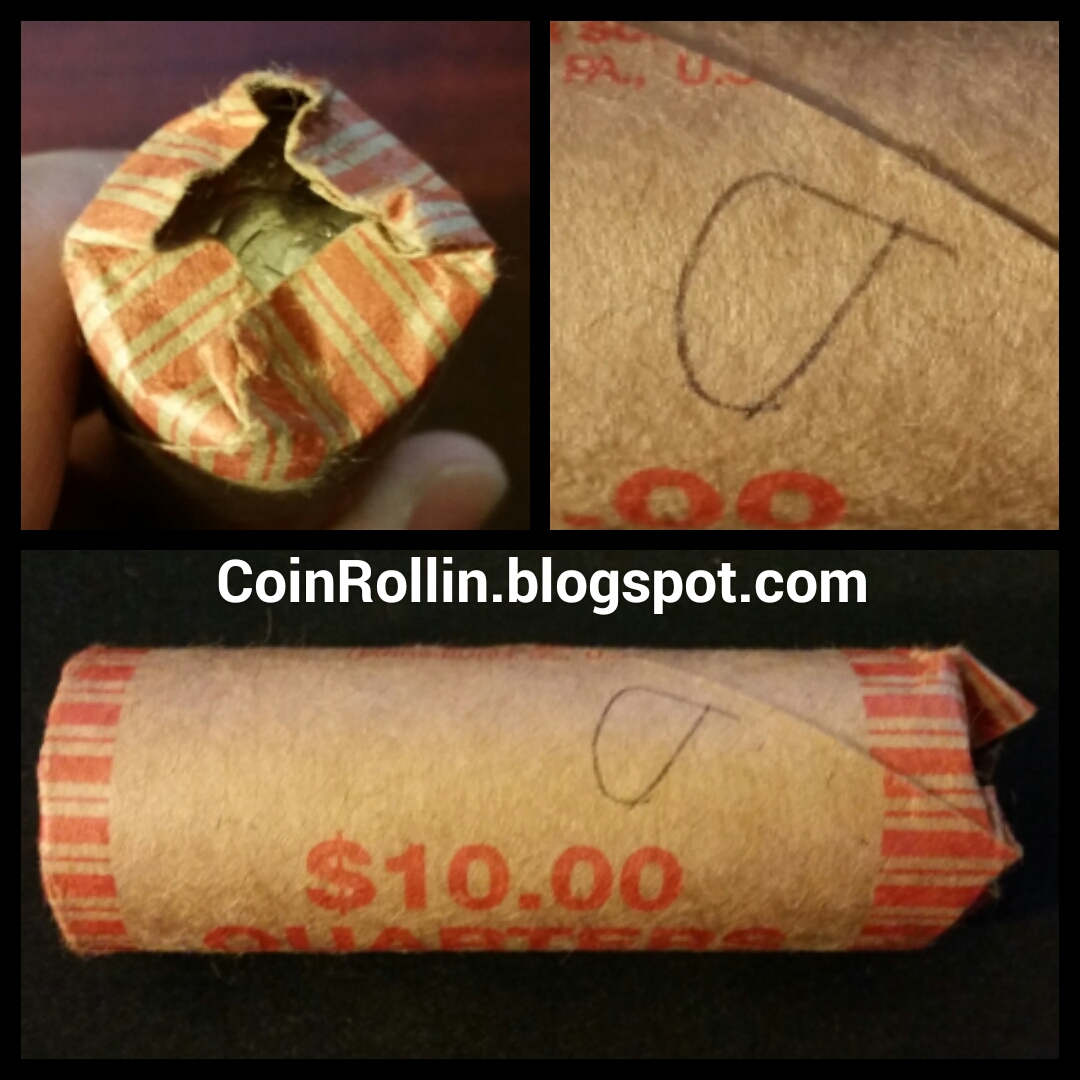
I also received a hand-wrapped roll with a mark on it.

Here is what I found:


As you can see, I picked up quarters instead of pennies but, I think the same logic will apply.

Without an image, I was unable to determine exactly what type of mark you had on your coin wrapper. So, follow along with me as I examine the similar instance I encountered on my roll of quarters and apply it to your own roll of pennies.

First, let's take a look at the condition of the wrapper.

Does the wrapper look well-worn and previously used?

Let's identify what kind of paper wrapper we're dealing with and why it is used.

What we have here, with my roll of quarters, is a partially crimped, open-ended wrapper which is typically used with a small Rapid Coin Sorting Machine.

This gives me some hope because there are a few reasons why someone would choose to use a machine like this to wrap their coins.

1) Closing out a cash register till by simply dumping the loose chang into the machine and letting it sort and count it out for you, quickly. In this case, no one is paying close attention to what's going into the hopper and are more concerned with the value of the change as currency. Good news for coin roll hunters like ourselves.

2) Someone could have received this as a gift or bought it for themselves. They place it on their kitchen counter or their dresser as a way of easily sorting out the day's loose change. Again, no one is paying close attention to what's going in and this is great news for coin roll hunters.

Typically, coin roll hunters would be dealing with a single type of coin at a time, and it would not be necessary to use such a machine to process these large amounts of coins, though it could always be possible. First of all, the type of wrappers this machine uses cost more than a flat coin wrapper, which is open on both ends and costs less money. This would make more sense because a coin roll hunter would need a lot of wrappers.

If your wrapper is a partially crimped, open-ended wrapper like the one on my roll of quarters, you might still have luck finding something in it. Unless the folded over flaps of the open end look worn, with either type of wrapper.

Let's take a closer look at the open end flaps in the upper left-hand image, above.
Concerning my own quarter roll, the flaps look very well-worn indeed.

What's that mean? 
Well, it simply means that the flaps have been opened and closed many times. Again, there could be a couple of reasons for this.

1) They have been recycled. At the beginning of the day, someone opening the till of their cash register simply dumped the coins into the tray and then reloaded the wrapper after they closed out. These types of wrapper are more expensive, remember, so it doesn't make sense to just break them open and throw them away. So, there might be some goodies in there.

On the other hand...

2) Another coin roll hunter requested them so he could search them and re-wrap them. Once again, they are dealing with a large quantity of coins and don't want to lose money on buying new wrappers. So, in this case, there might not be anything at all worth keeping in the roll.

So, wrapper type and condition, still might not be enough to tell what exactly you've got. Let's keep asking questions.

Does the mark look like it was placed intentionally?
Look closely at the upper right-hand image.

This mark was made with a pen and two separate lines that seem to form a letter D. Two marks in that kind of formation seem intentional to me, as if someone may have put their initial on it. Possibly, marking it off for some reason.

With concerns to the mark on your wrapper, I have seen many different types of intentional marks.
- A black marker stripe along the length of the roll
- Two letters, indicating a first and last name initial
- a check mark
- and a squiggly line in pen down the length of the wrapper.

In my experience, there seem to be three types of marks on wrappers: letters, lines and inccidentals. Let's get into each.

Letters
Letters could possibly be used by a cashier to verify the amount of coin inside the roll.
In this way, they might use their initials to sign-off on the contents of the roll in a way that shows they are accountable for verifying the contents of the roll.

This could happen when someone in a business is closing out of a cash register after their shift or making a counter deposit at the bank from the company's vault.

Another way a coin might be marked with a letter, could be a collector labeling the roll for a specific mint mark. In this case you would expect to see a: P, D, or S. In the case of my roll of quarters, there is a D. A collector could have been labeling a collection of quarters from the Denver Mint. Unfortunatly, when we went though these quarters, they were mixed marks. Which indicates to me that, maybe a collector did in fact turn in his collection to a bank, but someone has beaten me to them and re-used the wrapper. But, this would typically be a good sign on a hand-wrapped roll.

Hopefully, your roll shows this type of coin wrapper mark. This would indicate that it would contain coins from circulation that have not been searched.

Lines
Concerning the other type. Lines running along the length of the wrapper.
These lines tend to be noticeable from a distance. Thick, black marker lines, or scribbles.

The case for this type of wrapper mark could indicate that your bank might be a coin dump for another coin roll hunter in the area. The intention is to mark the wrapper in such a way, making it easily identifiable, so they know they have already searched that roll before and taken all the "goodies" out of it.

Other indicators for this type of behavior will be quantity. Productive coin roll hunters will order boxes of rolled coins and return them to the bank after they have searched through them. If they do come back for a smaller amount, they don't want to exchange their cash for rolls they have already searched for.

So, Thomas, if your mark runs the length of the roll, chances are you have a "skunk". Meaning, it stinks because you won't find anything worth keeping.

This is code for many coin roll hunters. But, it simply will not work 100% of the time, because wrappers can still be re-used if they are not broken.

So, you still have a chance!

Incidentals
These types of marks happen by accident. Usually, when someone is holding a pen to write a total.

1) They might point at each roll with the tip of the pen as they are counting, leaving little tic marks on the wrapper that don't necessarily mean anything.

2) The wrapper was stained by something and it looks like a mark or marker. Someone poured themselves coffee at the bank and a little bit of coffee dribbled down the edge of the mug. Then, for one reason or another, they could have set the mug on an open box of coins leaving a coffee ring along the edges of the wrappers that appears to be a brown marker mark.

3) Dirty fingers, maybe someone's pen leaked and they marked the rolls simply by handling them.

Any way it happens, they are usually unintentional and don't mean anything with regards to the contents inside. If you see marks like these, you're still in luck!

Now, let's get right down the meat of it, and dissect this roll!:

CLICK HERE TO SEARCH THIS MARKED ROLL OF QUARTERS!

So, I hope that answered your question, Thomas.
And, Welcome to the Coin Roll Hunt!

Be sure to keep growing your numismatic knowledge with these great books!
1) A Guide Book of United States Coins 
2) The Complete Guide to Lincoln Cents

Happy Hunting!

~Matthew, The Great Coin Roll Hunter
CoinRollin411@gmail.com
Matthew The Great Coin Roll Hunter on YouTube


Monday, February 27, 2017

BIRTHDAY COIN COLLECTION: COIN ROLL HUNTING FOR A 1983 D WASHINGTON QUARTER

Welcome back, Coin Roll Hunters!

We have had quite the adventure exploring our birthday coin collection.
Let's see how we are doing on our list...

1983 D -Penny
1983 D - Nickel
1983 D - Dime
1983 D - Quarter
1983 D - Half Dollar

Today, we will be searching three rolls of quarters for a 1983 D Washington Quarter!

Pick a roll to search:
Roll 1: Customer-Wrapped Roll
Roll 2: Bank-Wrapped Roll
Roll 3: Bank-Wrapped Roll

I hope you like the new coin roll hunting set up.
Now you're in control of the coin roll hunting experience.
Comment below to let me know what you thing.

Now, on to our find!


When you first encounter a new coin, it's important to learn some basic numismatic information.

Ask yourself these 5 simple questions:

1) What type of coin is this?
    By looking at the reverse side, we can see the phrase "Quarter Dollar" below the image of the eagle. Sure, this all seems very basic, but it's also very important. Out of all the coins this could be, we have now narrowed it down to one very specific group.

Now we know that we have a quarter. Not a penny, a nickel or a dime, but, a quarter.

So, let's get specific.

2) What type of Quarter is this?
     This question may seem a bit confusing at first, as you might not have realized that the quarter, as we know it today, used to look very different.

This is a great time to reference our guide book:
A Guide Book of United States Coins: The Official Red Book

With our guide book at hand, turn to the section about quarters.
Here you will see all the different designs that the quarter has had in the past.

One way to narrow down our search for what type of quarter we have is to look at the date on the obverse side of our coin.

This one reads, 1983.

Now, look up the date, 1983 in the quarter section of our guidebook.
Follow the dates backward with your finger, 1982, 1981, 1980, keep going until you reach the design header. It will read, "WASHINGTON (1932 TO DATE)"

Here you will see why we call this type of quarter a "Washington Quarter."

In 1932 the design of Standing Liberty was replaced by a portrait of the first President of the United States of America, George Washington.

Now we know we have a Washington Quarter!

3) Which mint produced our 1983 Washington Quarter?
     We have already had some practice looking for mint marks. So, you will know what type of mint marks to look for and what each one will indicate.

Bring out your magnifying glass.

Closely examine the obverse side of our Washington Quarter.
Did you find it?
You will spot the mint mark just behind his neck.

The coin in this example shows a "D".

Now we know that our 1983 D Washington Quarter was minted at the Denver Mint in Colorado!

4) What is the composition of our coin?
     We have already explored the composition of nickels and searched for silver in dimes. So, you might already realize that coins can be made of many different types of metals.

So, what is our Washington Quarter made of?
Once again, we will refer to our guide book.

You will notice that in the description for the first Washington Quarter, you will see that the coins from 1932 to 1964 were composed of 90% silver and 10% copper. You may have already heard these coins called, "Silver Quarters". This is because of their silver content.

Now, run your finger down the list of dates to 1965.

What happened on that date?
     Our guide book tells us that the composition of the Washington Quarter was changed! Instead of using silver, they replaced it with a less expensive metal; nickel. But, it's more interesting than that!

By sandwiching a core layer of 75% copper between two thin layers of 25% nickel, the cost to produce a quarter went down. This method produces what we call a "clad" coin.

Clad coins are easily identifiable by the band of copper exposed in the edges of a coin.

Let's take a look at the edge of our 1983 D Washington Quarter.


See that band of copper in the edge?
That is the easiest way to tell if you have a clad coin.

Now we know that our 1983 D Washington Quarter is clad, and composed of 75% copper and 25% nickel.

5) How many coins of this type were made?
     To answer this question, simply slide your finger forward through the dates to find 1983D again. Now, follow the dotted line to the right.......to find a number under the column "Mintage".

Mintage refers to the quantity of a coin that was produced at a specific mint for a specific year.

Following the dotted line for 1983D, we see that the Denver Mint produced 617,806,446 coins!

AMAZING!!!

We now have in our possession, 1 out of 617,806,446 coins! Another one will never be made and coins of this date will continue to be lost, damaged and destroyed, every day of every year; never to be seen again.

That's why it is so important for us to take great care of our coins.
By becoming a numismatist, you must also become a curator for your collection. Make sure to wear gloves when handling your coins and store them in a dry location.

From this moment on, you are responsible for a piece of history that can never be replaced.

We will go further into storing and displaying our coins in a future blog. But, for now, let's just enjoy our find!

Subscribe to my YouTube Channel to see other videos and playlists not included in this blog.

And, keep growing your numismatic knowledge with these great books!
1) Handbook of United States Coins: Official Blue Book
2) A Guide Book of Washington and State Quarters: Complete Source of History, Grading, and Prices

Until next time,
Happy Hunting!


BIRTHDAY COIN COLLECTION: DIMES

Welcome back, Coin Roll Hunters!

Too bad we didn't come up with any silver while coin roll hunting for wartime nickels, but we won't give up!

Today, we will continue with our Birthday Coin Collections. So, gather your dimes and your numismatics gear as we search for the next coin in this series.

CLICK HERE to join my search for a 1983D Roosevelt Dime in a bank-wrapped roll.

This has been a great hunt so far! We've had some success, but this coin is a bit worn.

CLICK HERE to search through the customer-wrapped roll to see if we can find a 1983D Dime in better condition.

Alright! We've searched through two rolls of dimes and found two 1983D Roosevelt Dimes in two different conditions.

This is a great way to find the best coins for our collection. When you are coin roll hunting, if you come across multiple coins your are looking for, put them all aside and compare them to each other. Then you can choose only that coin that you like best for your collection.

Just remember, the more rolls of coins you search, the more success you will have coin roll hunting. It's all about volume.

Thanks for joining me for our search for dimes. We are one step closer to completing our Birthday Coin Collections!

Let me know how your dime hunt went in the comments below and be sure to leave any of your coin-related questions.

Join me next time as we learn some tips on how to grade your coins.

Continue growing your numismatic knowledge with these great books!
1) Handbook of United States Coins: The Official Blue Book
2) Dimes by Mary Hill

Happy Hunting!


Sunday, February 26, 2017

COIN ROLL HUNTING SILVER WARTIME NICKELS

Welcome back, Coin Roll Hunters!

We are moving right along on our first coin collection, the BIRTHDAY COIN COLLECTION!

Here is our collection, so far:
1983D Lincoln Memorial Penny
1983D Jefferson Monticello Nickel.

Since we are coin roll hunting Jefferson Nickels, I thought we should take a moment to consider another exciting aspect of coin collecting; coin composition.

Composition refers to the materials used to make the blank metal disk which is struck at the mint to create a coin. This blank metal disk is called a, planchet.

The first Jefferson Nickels, which featured the Monticello reverse, had a composition of 75% Copper and 25% Nickel. But, something interesting happened in 1942.

America was in the middle of World War II and there was an increased demand for the metals Nickel and Copper to support the war effort. In order to meet the rising demand, the composition of the Jefferson Nickel was changed during production in 1942 to include 56% Copper, 35% Silver, and 9% Manganese. The new silver nickels were produced until 1945.

These Silver Wartime Nickels were also set apart by a special mint mark that was larger. But rather than including them below the date on the obverse side, the mint marks of P, D, and S, were placed on the reverse side above the image of the Monticello building.

CLICK HERE to join me as we search our first roll for Silver Wartime Nickels. Keep your eyes open for the large mint marks above the Moticello Building!

CLICK HERE to hunt through the customer-wrapped roll!

How did you do with your silver wartime nickel hunt?

Let me know in the comments below and be sure to add your coin-related questions.

Join me here next time as we continue with our Birthday Coin Collections.
You will need two rolls of dimes; a bank-wrapped roll and a customer-wrapped roll.

Continue growing your numismatic knowledge with these great books!
1) Handbook of United States Coins: The Official Blue Book
2) Profitable Coin Collecting

Happy Hunting!


LINCOLN SHIELD PENNY IN REVIEW

Welcome to another great numismatic adventure!

Let's take a closer look at the reverse of our Lincoln Shield pennies.


This design was first introduced in 2010 as the latest long-running design for the Lincoln penny. It is also the seventh reverse design of this coin since it was first produced in 1909.

The shield design is sometimes referred to as the "Union Shield" or the "Shield of Union" and has been used before on some earlier designs of American coinage, medals, and tokens.

Traditionally, the Union Shield has come to symbolize the importance of uniting the 13 original Colonies into one country; The  "United States of America" which you will find written above the Union Shield along the rim.

Looking closely now, we can break down the elements that make up the Union Shield.

You will notice 13 stripes running vertically down the lower part of the shield. There is one stripe for each of the 13 original colonies which formed into States.

At the top of the Union Shield, you will notice that the stripes are united by a crossbar, that symbolizes the Federal Government.

Across the crossbar, you will read a phrase written in Latin, "E PLURIBUS UNUM" In English this translates to, "One From Many." This was America's first motto, and refers to forming one country from many States. If you count the number of letters in the Latin phrase, you might be surprised to discover, there's 13 of them, too!

The refreshed design of our traditional symbol of our country's unity, is meant to honor Abraham Lincoln for preserving the unity of the United States of America during the Civil War that threatened to tear them apart.

What a beautiful specimen to show us that a coin does not have to be old or expensive to be interesting and worth collecting.

Add your thoughts about the new penny design in the comments below. Also, include any coin-related questions you might have, and don't forget to follow this blog for our next exciting coin roll hunt.

Build your numismatic knowledge with these great books!
1) A Guide Book of United States Coins: The Official Red Book
2) The Complete Guide to Lincoln Cents


Happy Hunting!


HUNT #2: FIND A LINCOLN SHIELD REVERSE PENNY

Hello, Coin Roll Hunters!

Thank you for joining me as I guide you through another exciting coin roll hunt!

Here is today's goal:

HUNT #2: Find a Lincoln, Sheild Reverse Penny.

CLICK HERE to join me in the hunt!

Be sure to follow this blog to join me on our next numismatic adventure when we will be taking a closer look at our new finds.

Also, let me know how your own coin roll hunt went, and include any coin-related questions or ideas you have for other coin roll hunts you would like to do, with your comments below.

Be sure to keep growing your numismatic knowledge with these great books!
1) A Guide Book of United States Coins: The Official Red Book
2) Pennies by Mary Hill

Happy Hunting!

Wednesday, February 22, 2017

COIN ROLL HUNTING SILVER ROOSEVELT DIMES

Welcome back, Coin Roll Hunters.

You're in for a treat! I had so much fun coin roll hunting for Silver Wartime Nickels, I thought we should go on another silver hunt. I hope you brought your customer-wrapped and bank-wrapped rolls of dimes because we will be coin roll hunting for more silver from Roosevelt dimes!

Modern Roosevelt dimes, as we know them today, are composed of sandwiched metal we call clad. 
Roosevelt dimes from 1965 to date are composed of an inner core layer of pure copper, clad between outer layers of a copper-nickel alloy of 75% copper and 25 nickel%.

What are dimes from 1964 and earlier made of?
They used silver! Yes, Roosevelt dimes minted from 1946 to 1964 are composed of a silver-copper alloy consisting of 90% silver and 10% copper. That's about .07234 oz. of pure silver!

Why was the composition of the dime changed in 1965?
Due to the increased value of silver in the early 1960's, it would cost the mint more than 10 Cents to make a Dime. In order to make the coin less expensive to produce, they passed the Coinage Act of 1965 to remove the silver content from the dime and substituted a clad copper-nickel alloy.

Are all Dimes made before 1964 made with silver?
Yes! So, as we coin roll hunt through our Roosevelt Dimes, keep an eye out for dimes made in 1964 or earlier.

Let's get started!

I hope you enjoy the new video format as I search for silver Roosevelt Dimes from a customer-wrapped roll and a bank-wrapped roll.

 CLICK HERE and join the hunt!

Thank you for joining me on another great silver hunt. Add your comments below and share your own coin roll hunting experience. Feel free to add any coin-related questions as well.

Also, be sure to Subscribe to my YouTube Channel to get even more videos not posted on the blog. Be sure to Share, Like and Comment on what you like, so I can continue to produce content you want to watch and enjoy.

And, keep expanding your numismatic knowledge with this great book!
1) The Complete Guide to U.S. Junk Silver Coins

Happy Hunting!

Monday, February 20, 2017

How To Grade Roosevelt Dimes

Welcome back, Coin Roll Hunters!

I will guide you through another numismatic adventure as we begin to explore the detailed work of grading your coins!

Grading coins provide us with a systematic way to describe the condition and appearance of our coins.

Let's take a closer look at the Roosevelt Dimes we found yesterday.


The one on the left was found in the customer-wrapped roll and the one on the right came out of the bank-wrapped roll.

At this point, it's important to use our gear.

A great book to start us off on this topic is:
The Official American Numismatic Association Grading Standards for United States Coins

According to their website:
"The American Numismatic Association is a nonprofit educational organization dedicated to educating and encouraging people to study and collect coins and related items. The ANA serves the academic community, collectors and the general public with an interest in numismatics."

The ANA will be another great resource for you as you continue to grow. But, let's get back to the coin at hand!

What we have here is a 1983D Roosevelt Dime in circulated condition, meaning that it has been passed around and handled. But, the coin on the left looks better than the one on the right? What we want to figure out is, How much better is the coin on the left against the coin on the right?

So, we could get into a very detailed discussion about the intricacies of grading, but that might scare you off. For now, let's just take an overhead view and if you're interested in learning more, you can explore the reference materials I've provided above.

The ANA breaks their system into 8 major groups:

(MS) Mint State, which shows no traces of wear.

(AU) About Uncirculated, with a little wear shown on the highest points.

(EF) Extremely Fine, with even more wear shown on the highest points.

(VF) Very Fine, moderate wear across the whole coin but the major features are still sharp.

(F) Fine, a bit more wear across the whole coin, but the design of the coin is still clear.

(VG) Very Good, this is a well-worn coin with flat spots in the design and which lacks details.

(G) Good, Even more heavily worn, The designs are visible, but the details are faint in spots.

(AG) About Good, Extremely worn smooth, with parts of the date hard to read, and details are mostly worn away.

And each major group is sub-divided into lesser groups, but we won't go into that right now. Let's just figure out, which major group our coins fall into. So, grab your magnifying glass and turn on a bright light. Let's get to it!

I like to start for from the top of the groups.

Right away, we see traces of wear in both coins. So, this will quickly eliminate the Mint State group.

Next is About Uncirculated. Take a closer look at the high points of the coins. These will be President Roosevelt's temple area behind his eye on the obverse and the flame of the torch on the reverse. Concerning our coins, I see wear in both those areas on the obverse. So, we will continue on to the next grade.

How about Extremely Fine? This condition focuses on only the highest points of the coin. On the obverse, they will be the hair lines above the ear, the cheeks, the ear itself. On the reverse, they will be the details of the flame, and the lines on the torch. Overall, we must also consider the luster of the coin. Luster is the shininess of the coin. Right away, we see that both of these coins are dull. That will exclude them from this group.

Then, there is Very Fine. Is there light, even wear? Are all the major features sharp? Look closely, now. On the obverse, can you see the details in the hair? The ear? and the cheeks? On the reverse, are the lines of the torch defined? How about details on the leaves? We are beginning to narrow it down now. The dullness of both coins shows light even wear. Also, there are still details in the hair, and ear of both coins, but they are smooth. However, the coin on the right shows rub marks on the highest points, which are not present on the coin on the left. Let's keep going.

Fine condition. Do the coins show moderate to heavy wear?  I would say, "Yes". Is the entire design clear and bold? "Yes" again. So, what about the details in the hair? Are half the details worn away? For this question, it would be a good idea to find a coin from the latest year. Something from 2016 would be fine. Compare the lines in the hair you see to this newest coin, against the lines you see in your birthday coin. My two coins from 1983 are showing more wear on the hair lines. I would feel comfortable placing them in this group more than the one above. Let's keep digging.

What about Very Good? Are the coins well worn over all? Are the designs clear, but flat in the high points and lacking details? Clearly, these coins are still showing their high points. Tilting the coin at a sharp angle under the light, there is no evidence of any flat areas of the highest points. We can still make out the detail lines in the hair. So, I think the coins we have are both in a higher grade than very good. 

This is a good place to stop. Both coins appear to be in Fine condition. But, the coin on the left has less wear than the coin on the right. This is when you will get into studying the details of the subclasses.

As you gain more experience, you will learn to identify the finer details of the subclasses. But, for now, I think we're safe calling these coins Fine condition coins. And we will just drop the one on the right back into circulation, as it is clearly less attractive than the one on the left.

So, there you have it. This is a great way to get to know your coins and appreciate the artistry of their designs. Grading your coins will make it easier to identify better coins out of the pile more quickly, and make the quality of your collections much more appealing.

Thank you for joining me on another numismatic adventure and add your comments and coin-related questions below. 

Be sure to Subscribe to my YouTube Channel to get even more videos! And, be sure to Like and Comment as well, so that I can continue to produce content you enjoy and want to see.

Get ready for our next big hunt! 

You will need two rolls of coins.
1 - bank-wrapped roll of dimes.
1 - customer-wrapped roll of dimes.

Happy Hunting!


Friday, February 17, 2017

1983D JEFFERSON NICKEL AND CLEANING YOUR COINS

Welcome back, Coin Roll Hunters!
That was one of the best coin roll hunts we've had so far.

The 1983D Jefferson Nickel is the second coin in our Birthday Coin Collection, right after the 1983D Penny. This coin really hid from us until the last moment but, I think that's all part of what makes coin roll hunting so much fun. Anyway, we got it and here it is.

Behold the 1983D Jefferson Nickel!


On closer inspection, you'll notice that this coin has got some grime between the 8 and 3 in the date, as well as on President Jefferson's chin. You might be tempted to scrub it away, but I urge you not to clean your coins. Ever!

But, you said this was my collection and I could do with it whatever I wanted?
Yes, I did say that. And, there's no way for me to physically stop you from cleaning your coins. But, as a Numismatist, it's important to realize that we are also curators of our coins and collections.

What does it mean to be a curator
As curators, we are expected to care for the good of our coins, protecting them from damage while they are in our possession.

As you hunt through more rolls of coins, you will find plenty of road-battered and abused coins. Scratches, burns, scrapes, and stains; all kinds of things can damage a coin during its lifetime. So, it's important that we don't add to a coins destruction.

Even improper handling of a coin by using our bare hands without wearing gloves will transfer skin oils onto the surface and damage the tone, or color, of your coin.

Harsh chemicals can also damage the tone, but even by scrubbing grime away with the softest brush, you will create micro-scratches. These are scratches you won't be able to see with your unaided eye but they are easily seen under a microscope. The results will be a lesser grade for your coin and ultimately, by cleaning your coins you will make them less valuable to another collector.

Worst of all, by neglecting your responsibilities as a curator you can cause irreversible damage to your beloved coins, which means you can't repair them. Generations of Numismatists after you, your grandchildren's grandchildren, will lose the opportunity to see your collections in their best condition.

But, I've watched your videos and you don't wear gloves. What gives?
Excellent observation! Now you're beginning to think like a serious Numismatist. The reason I'm not wearing gloves when we coin roll hunt is because the coins we are searching are already tarnished by circulation, being handled as day-to-day currency. But, occasionally, we will find a coin that is shiny and new. At that point, you will want to put your gloves on before handling this coin, especially if you are going to press the coin into your coin folder or album!

What's the important takeaway here?
As Numismatists, we are responsible for the condition of our coins while they are in our possession. If we cause damage to our coins it is our fault and it is at the expense of future generations, as they will miss out on seeing your coin and collection in its best condition.

In addition to our other coin collecting gear, let's get some nice cotton gloves so we don't ruin the tone on our bright, shiny coins, and remember, DON'T EVER CLEAN YOUR COINS!!!

Let me know what you think about cleaning coins in the comments below, and be sure to get ready for our next Coin Roll Hunt!

Go out into the world and get yourself two more rolls of nickels, one in a bank-rolled wrapper and another in a customer-rolled wrapper. And, gather your gear, because the next coin roll hunt is going to be even more fun! See you next time.

Continue growing your numismatic knowledge with these great books!
1) Handbook of United States Coins: The Official Blue Book
2) The Dirty Little Secrets About Cleaned Coins: A Common Sense Handbook on Coin Cleaning

Happy Hunting!


Wednesday, February 15, 2017

BIRTHDAY COIN COLLECTION: NICKEL

Welcome back, Coin Roll Hunters!

Now that we've gotten some experience coin roll hunting, it's time to complete our first collection.

Our birthday coin collection!

We have already found our Birthday penny from our first coin roll hunt.

Mine was a 1983D Lincoln Memorial penny.

Now, we just need a list of coins to include in our collection.

Here is the list for my 1983 Birthday Coin Collection:

1983 D -Penny
1983 D - Nickel
1983 D - Dime
1983 D - Quarter
1983 D - Half Dollar

My Birthday Penny had a Denver mint mark on it. To keep my collection more cohesive, meaning to include as many similar details as I can throughout the theme of the collection, I decided to include only those coins that have the "D" mint mark on them.

You may like a different mint mark and that's great! The main thing to remember is that this is your Birthday Coin Collection. So, pick a mint mark that you like and go from there.

Now on with the hunt!

We have two rolls of nickels to search today. One roll is a white bank-wrapped roll. The other is a striped customer-wrapped roll. This should give us a good mix of coins to search through.

CLICK HERE to open the bank-wrapped roll.

CLICK HERE to open the customer-wrapped roll.

Be sure to join us here next time when we'll take a closer look at this coin. Share your experience looking for your Birthday Nickel in the comments below and include any coin-related questions you might have.

Keep building your numismatic knowledge with these great books!
1) A Guide Book of United States Coins: The Official Red Book
2) A Guide Book of Buffalo and Jefferson Nickels

Happy Hunting!

Thursday, February 9, 2017

Welcome To The Coin Roll Hunt!

Thank you for joining me on this most bodacious adventure! You have taken a great step forward towards making 2017 a wonderful year!

My name is Matthew, The Great Coin Roll Hunter, and I will be your Guide to the exciting world of numismatics.

The word numismatics refers to the study or collection of coins, paper currency, and medals. By joining in on the hunt today, you have become initiated into a very fun, and very cool, Society of Numismatists; those who collect numismatic items, which includes coins. Welcome!

Before we get started, we will need to gather some supplies.

A field guide is one of the most important items every great coin roll hunter will need.

I recommend: The Official Red Book: A Guide Book of United States Coins 2017

In the 70th Edition of this book, you will get a great introduction to United States Coins. There is information about the different types of coins the United States has minted, and other great details which include the metal content of each coin, as well as information on how to grade coins yourself to determine their generally agreed upon numismatic values. That means you will discover how much your coin might be worth to someone else. It's important to realize that the more you learn, the more you will enjoy this hobby.

As you explore the loose change on the dresser, between the couch cushions or, in the ashtray of the car, you will soon find it helpful to keep your coins organized. Coin albums and coin folders are a great way to do this.

I recommend: Whitman coin folders

Whitman coin folders are inexpensive and durable. They also feature a push to lock design that secures your coins into place. This feature makes these coin folders a great way to store and share your coin collections with your friends and family.

Finally, you will need a magnifying glass.

The extra magnification helps you to inspect the finer details of your coins. I recommend something in the range of 7X or 10X magnification. But, if you're really clever with your smartphone, you can use the zoom-in feature on your camera app. It's also a great way to take photos of your coins and share them with your friends on-line.

Well, that's all I have for you now. Gather up your equipment and don't forget to subscribe so you won't miss out on our first great coin roll hunt, which will be coming up soon!

See you then!