Welcome back, Coin Roll Hunters!
We are moving right along on our first coin collection, the BIRTHDAY COIN COLLECTION!
Here is our collection, so far:
1983D Lincoln Memorial Penny
1983D Jefferson Monticello Nickel.
Since we are coin roll hunting Jefferson Nickels, I thought we should take a moment to consider another exciting aspect of coin collecting; coin composition.
Composition refers to the materials used to make the blank metal disk which is struck at the mint to create a coin. This blank metal disk is called a, planchet.
The first Jefferson Nickels, which featured the Monticello reverse, had a composition of 75% Copper and 25% Nickel. But, something interesting happened in 1942.
America was in the middle of World War II and there was an increased demand for the metals Nickel and Copper to support the war effort. In order to meet the rising demand, the composition of the Jefferson Nickel was changed during production in 1942 to include 56% Copper, 35% Silver, and 9% Manganese. The new silver nickels were produced until 1945.
These Silver Wartime Nickels were also set apart by a special mint mark that was larger. But rather than including them below the date on the obverse side, the mint marks of P, D, and S, were placed on the reverse side above the image of the Monticello building.
CLICK HERE to join me as we search our first roll for Silver Wartime Nickels. Keep your eyes open for the large mint marks above the Moticello Building!
CLICK HERE to hunt through the customer-wrapped roll!
How did you do with your silver wartime nickel hunt?
Let me know in the comments below and be sure to add your coin-related questions.
Join me here next time as we continue with our Birthday Coin Collections.
You will need two rolls of dimes; a bank-wrapped roll and a customer-wrapped roll.
Continue growing your numismatic knowledge with these great books!
1) Handbook of United States Coins: The Official Blue Book
2) Profitable Coin Collecting
Happy Hunting!
Sunday, February 26, 2017

LINCOLN SHIELD PENNY IN REVIEW
Welcome to another great numismatic adventure!

This design was first introduced in 2010 as the latest long-running design for the Lincoln penny. It is also the seventh reverse design of this coin since it was first produced in 1909.
The shield design is sometimes referred to as the "Union Shield" or the "Shield of Union" and has been used before on some earlier designs of American coinage, medals, and tokens.
Traditionally, the Union Shield has come to symbolize the importance of uniting the 13 original Colonies into one country; The "United States of America" which you will find written above the Union Shield along the rim.
Looking closely now, we can break down the elements that make up the Union Shield.
Looking closely now, we can break down the elements that make up the Union Shield.
You will notice 13 stripes running vertically down the lower part of the shield. There is one stripe for each of the 13 original colonies which formed into States.
At the top of the Union Shield, you will notice that the stripes are united by a crossbar, that symbolizes the Federal Government.
Across the crossbar, you will read a phrase written in Latin, "E PLURIBUS UNUM" In English this translates to, "One From Many." This was America's first motto, and refers to forming one country from many States. If you count the number of letters in the Latin phrase, you might be surprised to discover, there's 13 of them, too!
The refreshed design of our traditional symbol of our country's unity, is meant to honor Abraham Lincoln for preserving the unity of the United States of America during the Civil War that threatened to tear them apart.
What a beautiful specimen to show us that a coin does not have to be old or expensive to be interesting and worth collecting.
Add your thoughts about the new penny design in the comments below. Also, include any coin-related questions you might have, and don't forget to follow this blog for our next exciting coin roll hunt.
Build your numismatic knowledge with these great books!
1) A Guide Book of United States Coins: The Official Red Book
2) The Complete Guide to Lincoln Cents
Build your numismatic knowledge with these great books!
1) A Guide Book of United States Coins: The Official Red Book
2) The Complete Guide to Lincoln Cents
Happy Hunting!
HUNT #2: FIND A LINCOLN SHIELD REVERSE PENNY
Hello, Coin Roll Hunters!
Thank you for joining me as I guide you through another exciting coin roll hunt!
Here is today's goal:
HUNT #2: Find a Lincoln, Sheild Reverse Penny.
CLICK HERE to join me in the hunt!
Be sure to follow this blog to join me on our next numismatic adventure when we will be taking a closer look at our new finds.
Thank you for joining me as I guide you through another exciting coin roll hunt!
Here is today's goal:
HUNT #2: Find a Lincoln, Sheild Reverse Penny.
CLICK HERE to join me in the hunt!
Be sure to follow this blog to join me on our next numismatic adventure when we will be taking a closer look at our new finds.
Also, let me know how your own coin roll hunt went, and include any coin-related questions or ideas you have for other coin roll hunts you would like to do, with your comments below.
Be sure to keep growing your numismatic knowledge with these great books!
1) A Guide Book of United States Coins: The Official Red Book
2) Pennies by Mary Hill
Happy Hunting!
Be sure to keep growing your numismatic knowledge with these great books!
1) A Guide Book of United States Coins: The Official Red Book
2) Pennies by Mary Hill
Happy Hunting!
MAKING CENTS OF PENNIES
Wellcome back, fellow Coin Roll Hunters!
Today we are going on a numismatic adventure.
So far we have gathered our gear, gone on a coin roll hunt in search of our Birth-Year penny, and learned about mint marks on Lincoln pennies. Now, I am going to explain the difference between a penny and a cent.
Let's begin by taking a closer look at the reverse of our Birth-Year Pennies.
Here is the reverse of my 1983D penny:

Take a look below the Lincoln Memorial, and you will notice the words "ONE CENT".
Have you ever wondered why it doesn't read "ONE PENNY"?
It can be broken down like this.
The word "Penny" is a common term that refers to a type of coin.
For example, here are some other types of American coins you are probably already familiar with:
These are the words we use commonly as a reference to certain types of American coins.
However, the word "Cent" is used as a reference to the face value of a certain type of coin.
1 Penny is equal to 1 Cent.
1 Nickel is equal to 5 Cents.
1 Dime is equal to 10 Cents.
1 Quarter is equal to 25 Cents.
So, a Cashier can give you 30 Cents but, that doesn't tell you what type of coins they have given to you. That person may have given you a quarter and a nickel or, three dimes. But, if you're really lucky, maybe they gave you 30 pennies!
Simply put, that's the difference between what is meant by the common term "Penny" and the value described as a "Cent". However, I did say this was a numismatic adventure.
Numismatically speaking, the word "Cent" is also used to describe a class of coins.
Oh, Brother!
Class refers to a category of things. For instance, American coins with face values that are less than one dollar. But, are also separated from each other by differences, such as type, size, or design. Each type of coin will create its own sub-class within the larger class of its category.
By classifying coins this way, the term "Cent" is applied to separate the classes and types of coins.
For an example, let's look at just the One Cent Pennies.
In the beginning, there is the class of Large Cents. That is to say, One Cent coins which were minted from 1793 to 1857, and which are different in some way from One Cent coins after 1857.
Indeed, these Large Cent coins were much larger in diameter than the pennies we use today. This is the reason why we have separated them out into their own class.
Large Cents were then followed by the class of Small Cents, which were minted from 1856 to the present.
Let me know what you think about pennies and cents in your comments below. Include any other coin-related questions or coin hunting ideas as well.
Today we are going on a numismatic adventure.
So far we have gathered our gear, gone on a coin roll hunt in search of our Birth-Year penny, and learned about mint marks on Lincoln pennies. Now, I am going to explain the difference between a penny and a cent.
Let's begin by taking a closer look at the reverse of our Birth-Year Pennies.
Here is the reverse of my 1983D penny:

Take a look below the Lincoln Memorial, and you will notice the words "ONE CENT".
Have you ever wondered why it doesn't read "ONE PENNY"?
It can be broken down like this.
The word "Penny" is a common term that refers to a type of coin.
For example, here are some other types of American coins you are probably already familiar with:
Penny, Nickel, Dime, and Quarter.
However, the word "Cent" is used as a reference to the face value of a certain type of coin.
1 Penny is equal to 1 Cent.
1 Nickel is equal to 5 Cents.
1 Dime is equal to 10 Cents.
1 Quarter is equal to 25 Cents.
So, a Cashier can give you 30 Cents but, that doesn't tell you what type of coins they have given to you. That person may have given you a quarter and a nickel or, three dimes. But, if you're really lucky, maybe they gave you 30 pennies!
Simply put, that's the difference between what is meant by the common term "Penny" and the value described as a "Cent". However, I did say this was a numismatic adventure.
Numismatically speaking, the word "Cent" is also used to describe a class of coins.
Oh, Brother!
Class refers to a category of things. For instance, American coins with face values that are less than one dollar. But, are also separated from each other by differences, such as type, size, or design. Each type of coin will create its own sub-class within the larger class of its category.
By classifying coins this way, the term "Cent" is applied to separate the classes and types of coins.
For an example, let's look at just the One Cent Pennies.
In the beginning, there is the class of Large Cents. That is to say, One Cent coins which were minted from 1793 to 1857, and which are different in some way from One Cent coins after 1857.
Indeed, these Large Cent coins were much larger in diameter than the pennies we use today. This is the reason why we have separated them out into their own class.
Large Cents were then followed by the class of Small Cents, which were minted from 1856 to the present.
1856 to 1857 was a transitional year and was used to show Congress how the newer, smaller, Flying Eagle Cents would look as the country transitioned into using the smaller diameter One Cent Pennies.
So, where do our Birth-Year Pennies fit in?
For that, all we need for reference is the date struck on the obverse of the coin.
My Birth-Year Penny shows 1983. This means it falls into a class of coins minted from 1856 to the present, known as Small Cents. And, the class of Small Cents includes many different sub-class designs:
The Flying Eagle (1856 - 1858)
The Indian Head (1859 - 1909)
The Lincoln, Wheat Ears Reverse (1909-1958)
The Lincoln, Memorial Reverse (1959-2008)
The Lincoln, Bicentennial (2009)
The Lincoln, Shield Reverse (2010 - Present)
Now, wasn't that easy?
So, where do our Birth-Year Pennies fit in?
For that, all we need for reference is the date struck on the obverse of the coin.
My Birth-Year Penny shows 1983. This means it falls into a class of coins minted from 1856 to the present, known as Small Cents. And, the class of Small Cents includes many different sub-class designs:
The Flying Eagle (1856 - 1858)
The Indian Head (1859 - 1909)
The Lincoln, Wheat Ears Reverse (1909-1958)
The Lincoln, Memorial Reverse (1959-2008)
The Lincoln, Bicentennial (2009)
The Lincoln, Shield Reverse (2010 - Present)
Now, wasn't that easy?
Let me know what you think about pennies and cents in your comments below. Include any other coin-related questions or coin hunting ideas as well.
Join me next time, as we continue to explore the class of Small Cents.
Keep growing your numismatic knowledge with these great books!
1) A Guide Book of United States Coins: The Official Red Book
2) The Power of the Penny: Abraham Lincoln Inspires a Nation
Keep growing your numismatic knowledge with these great books!
1) A Guide Book of United States Coins: The Official Red Book
2) The Power of the Penny: Abraham Lincoln Inspires a Nation
Happy Hunting!
Wednesday, February 22, 2017
COIN ROLL HUNTING SILVER ROOSEVELT DIMES
Welcome back, Coin Roll Hunters.
You're in for a treat! I had so much fun coin roll hunting for Silver Wartime Nickels, I thought we should go on another silver hunt. I hope you brought your customer-wrapped and bank-wrapped rolls of dimes because we will be coin roll hunting for more silver from Roosevelt dimes!
Modern Roosevelt dimes, as we know them today, are composed of sandwiched metal we call clad.
Roosevelt dimes from 1965 to date are composed of an inner core layer of pure copper, clad between outer layers of a copper-nickel alloy of 75% copper and 25 nickel%.
What are dimes from 1964 and earlier made of?
They used silver! Yes, Roosevelt dimes minted from 1946 to 1964 are composed of a silver-copper alloy consisting of 90% silver and 10% copper. That's about .07234 oz. of pure silver!
Why was the composition of the dime changed in 1965?
Due to the increased value of silver in the early 1960's, it would cost the mint more than 10 Cents to make a Dime. In order to make the coin less expensive to produce, they passed the Coinage Act of 1965 to remove the silver content from the dime and substituted a clad copper-nickel alloy.
Are all Dimes made before 1964 made with silver?
Yes! So, as we coin roll hunt through our Roosevelt Dimes, keep an eye out for dimes made in 1964 or earlier.
Let's get started!
I hope you enjoy the new video format as I search for silver Roosevelt Dimes from a customer-wrapped roll and a bank-wrapped roll.
CLICK HERE and join the hunt!
Thank you for joining me on another great silver hunt. Add your comments below and share your own coin roll hunting experience. Feel free to add any coin-related questions as well.
Also, be sure to Subscribe to my YouTube Channel to get even more videos not posted on the blog. Be sure to Share, Like and Comment on what you like, so I can continue to produce content you want to watch and enjoy.
And, keep expanding your numismatic knowledge with this great book!
1) The Complete Guide to U.S. Junk Silver Coins
Happy Hunting!
You're in for a treat! I had so much fun coin roll hunting for Silver Wartime Nickels, I thought we should go on another silver hunt. I hope you brought your customer-wrapped and bank-wrapped rolls of dimes because we will be coin roll hunting for more silver from Roosevelt dimes!
Modern Roosevelt dimes, as we know them today, are composed of sandwiched metal we call clad.
Roosevelt dimes from 1965 to date are composed of an inner core layer of pure copper, clad between outer layers of a copper-nickel alloy of 75% copper and 25 nickel%.
What are dimes from 1964 and earlier made of?
They used silver! Yes, Roosevelt dimes minted from 1946 to 1964 are composed of a silver-copper alloy consisting of 90% silver and 10% copper. That's about .07234 oz. of pure silver!
Why was the composition of the dime changed in 1965?
Due to the increased value of silver in the early 1960's, it would cost the mint more than 10 Cents to make a Dime. In order to make the coin less expensive to produce, they passed the Coinage Act of 1965 to remove the silver content from the dime and substituted a clad copper-nickel alloy.
Are all Dimes made before 1964 made with silver?
Yes! So, as we coin roll hunt through our Roosevelt Dimes, keep an eye out for dimes made in 1964 or earlier.
Let's get started!
I hope you enjoy the new video format as I search for silver Roosevelt Dimes from a customer-wrapped roll and a bank-wrapped roll.
CLICK HERE and join the hunt!
Thank you for joining me on another great silver hunt. Add your comments below and share your own coin roll hunting experience. Feel free to add any coin-related questions as well.
Also, be sure to Subscribe to my YouTube Channel to get even more videos not posted on the blog. Be sure to Share, Like and Comment on what you like, so I can continue to produce content you want to watch and enjoy.
And, keep expanding your numismatic knowledge with this great book!
1) The Complete Guide to U.S. Junk Silver Coins
Happy Hunting!
Monday, February 20, 2017
How To Grade Roosevelt Dimes
Welcome back, Coin Roll Hunters!
I will guide you through another numismatic adventure as we begin to explore the detailed work of grading your coins!
Grading coins provide us with a systematic way to describe the condition and appearance of our coins.
Let's take a closer look at the Roosevelt Dimes we found yesterday.
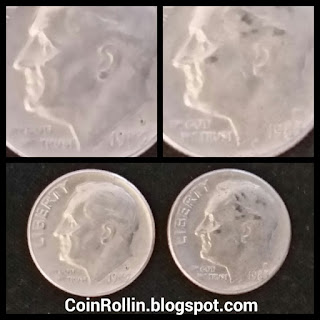
The one on the left was found in the customer-wrapped roll and the one on the right came out of the bank-wrapped roll.
At this point, it's important to use our gear.
A great book to start us off on this topic is:
The Official American Numismatic Association Grading Standards for United States Coins
According to their website:
"The American Numismatic Association is a nonprofit educational organization dedicated to educating and encouraging people to study and collect coins and related items. The ANA serves the academic community, collectors and the general public with an interest in numismatics."
The ANA will be another great resource for you as you continue to grow. But, let's get back to the coin at hand!
What we have here is a 1983D Roosevelt Dime in circulated condition, meaning that it has been passed around and handled. But, the coin on the left looks better than the one on the right? What we want to figure out is, How much better is the coin on the left against the coin on the right?
So, we could get into a very detailed discussion about the intricacies of grading, but that might scare you off. For now, let's just take an overhead view and if you're interested in learning more, you can explore the reference materials I've provided above.
The ANA breaks their system into 8 major groups:
(MS) Mint State, which shows no traces of wear.
(AU) About Uncirculated, with a little wear shown on the highest points.
(EF) Extremely Fine, with even more wear shown on the highest points.
(VF) Very Fine, moderate wear across the whole coin but the major features are still sharp.
(F) Fine, a bit more wear across the whole coin, but the design of the coin is still clear.
(VG) Very Good, this is a well-worn coin with flat spots in the design and which lacks details.
(G) Good, Even more heavily worn, The designs are visible, but the details are faint in spots.
(AG) About Good, Extremely worn smooth, with parts of the date hard to read, and details are mostly worn away.
And each major group is sub-divided into lesser groups, but we won't go into that right now. Let's just figure out, which major group our coins fall into. So, grab your magnifying glass and turn on a bright light. Let's get to it!
I like to start for from the top of the groups.
Right away, we see traces of wear in both coins. So, this will quickly eliminate the Mint State group.
Next is About Uncirculated. Take a closer look at the high points of the coins. These will be President Roosevelt's temple area behind his eye on the obverse and the flame of the torch on the reverse. Concerning our coins, I see wear in both those areas on the obverse. So, we will continue on to the next grade.
How about Extremely Fine? This condition focuses on only the highest points of the coin. On the obverse, they will be the hair lines above the ear, the cheeks, the ear itself. On the reverse, they will be the details of the flame, and the lines on the torch. Overall, we must also consider the luster of the coin. Luster is the shininess of the coin. Right away, we see that both of these coins are dull. That will exclude them from this group.
Then, there is Very Fine. Is there light, even wear? Are all the major features sharp? Look closely, now. On the obverse, can you see the details in the hair? The ear? and the cheeks? On the reverse, are the lines of the torch defined? How about details on the leaves? We are beginning to narrow it down now. The dullness of both coins shows light even wear. Also, there are still details in the hair, and ear of both coins, but they are smooth. However, the coin on the right shows rub marks on the highest points, which are not present on the coin on the left. Let's keep going.
Fine condition. Do the coins show moderate to heavy wear? I would say, "Yes". Is the entire design clear and bold? "Yes" again. So, what about the details in the hair? Are half the details worn away? For this question, it would be a good idea to find a coin from the latest year. Something from 2016 would be fine. Compare the lines in the hair you see to this newest coin, against the lines you see in your birthday coin. My two coins from 1983 are showing more wear on the hair lines. I would feel comfortable placing them in this group more than the one above. Let's keep digging.
What about Very Good? Are the coins well worn over all? Are the designs clear, but flat in the high points and lacking details? Clearly, these coins are still showing their high points. Tilting the coin at a sharp angle under the light, there is no evidence of any flat areas of the highest points. We can still make out the detail lines in the hair. So, I think the coins we have are both in a higher grade than very good.
This is a good place to stop. Both coins appear to be in Fine condition. But, the coin on the left has less wear than the coin on the right. This is when you will get into studying the details of the subclasses.
As you gain more experience, you will learn to identify the finer details of the subclasses. But, for now, I think we're safe calling these coins Fine condition coins. And we will just drop the one on the right back into circulation, as it is clearly less attractive than the one on the left.
So, there you have it. This is a great way to get to know your coins and appreciate the artistry of their designs. Grading your coins will make it easier to identify better coins out of the pile more quickly, and make the quality of your collections much more appealing.
Thank you for joining me on another numismatic adventure and add your comments and coin-related questions below.
I will guide you through another numismatic adventure as we begin to explore the detailed work of grading your coins!
Grading coins provide us with a systematic way to describe the condition and appearance of our coins.
Let's take a closer look at the Roosevelt Dimes we found yesterday.

The one on the left was found in the customer-wrapped roll and the one on the right came out of the bank-wrapped roll.
At this point, it's important to use our gear.
A great book to start us off on this topic is:
The Official American Numismatic Association Grading Standards for United States Coins
According to their website:
"The American Numismatic Association is a nonprofit educational organization dedicated to educating and encouraging people to study and collect coins and related items. The ANA serves the academic community, collectors and the general public with an interest in numismatics."
The ANA will be another great resource for you as you continue to grow. But, let's get back to the coin at hand!
What we have here is a 1983D Roosevelt Dime in circulated condition, meaning that it has been passed around and handled. But, the coin on the left looks better than the one on the right? What we want to figure out is, How much better is the coin on the left against the coin on the right?
So, we could get into a very detailed discussion about the intricacies of grading, but that might scare you off. For now, let's just take an overhead view and if you're interested in learning more, you can explore the reference materials I've provided above.
The ANA breaks their system into 8 major groups:
(MS) Mint State, which shows no traces of wear.
(AU) About Uncirculated, with a little wear shown on the highest points.
(EF) Extremely Fine, with even more wear shown on the highest points.
(VF) Very Fine, moderate wear across the whole coin but the major features are still sharp.
(F) Fine, a bit more wear across the whole coin, but the design of the coin is still clear.
(VG) Very Good, this is a well-worn coin with flat spots in the design and which lacks details.
(G) Good, Even more heavily worn, The designs are visible, but the details are faint in spots.
(AG) About Good, Extremely worn smooth, with parts of the date hard to read, and details are mostly worn away.
And each major group is sub-divided into lesser groups, but we won't go into that right now. Let's just figure out, which major group our coins fall into. So, grab your magnifying glass and turn on a bright light. Let's get to it!
I like to start for from the top of the groups.
Right away, we see traces of wear in both coins. So, this will quickly eliminate the Mint State group.
Next is About Uncirculated. Take a closer look at the high points of the coins. These will be President Roosevelt's temple area behind his eye on the obverse and the flame of the torch on the reverse. Concerning our coins, I see wear in both those areas on the obverse. So, we will continue on to the next grade.
How about Extremely Fine? This condition focuses on only the highest points of the coin. On the obverse, they will be the hair lines above the ear, the cheeks, the ear itself. On the reverse, they will be the details of the flame, and the lines on the torch. Overall, we must also consider the luster of the coin. Luster is the shininess of the coin. Right away, we see that both of these coins are dull. That will exclude them from this group.
Then, there is Very Fine. Is there light, even wear? Are all the major features sharp? Look closely, now. On the obverse, can you see the details in the hair? The ear? and the cheeks? On the reverse, are the lines of the torch defined? How about details on the leaves? We are beginning to narrow it down now. The dullness of both coins shows light even wear. Also, there are still details in the hair, and ear of both coins, but they are smooth. However, the coin on the right shows rub marks on the highest points, which are not present on the coin on the left. Let's keep going.
Fine condition. Do the coins show moderate to heavy wear? I would say, "Yes". Is the entire design clear and bold? "Yes" again. So, what about the details in the hair? Are half the details worn away? For this question, it would be a good idea to find a coin from the latest year. Something from 2016 would be fine. Compare the lines in the hair you see to this newest coin, against the lines you see in your birthday coin. My two coins from 1983 are showing more wear on the hair lines. I would feel comfortable placing them in this group more than the one above. Let's keep digging.
What about Very Good? Are the coins well worn over all? Are the designs clear, but flat in the high points and lacking details? Clearly, these coins are still showing their high points. Tilting the coin at a sharp angle under the light, there is no evidence of any flat areas of the highest points. We can still make out the detail lines in the hair. So, I think the coins we have are both in a higher grade than very good.
This is a good place to stop. Both coins appear to be in Fine condition. But, the coin on the left has less wear than the coin on the right. This is when you will get into studying the details of the subclasses.
As you gain more experience, you will learn to identify the finer details of the subclasses. But, for now, I think we're safe calling these coins Fine condition coins. And we will just drop the one on the right back into circulation, as it is clearly less attractive than the one on the left.
So, there you have it. This is a great way to get to know your coins and appreciate the artistry of their designs. Grading your coins will make it easier to identify better coins out of the pile more quickly, and make the quality of your collections much more appealing.
Thank you for joining me on another numismatic adventure and add your comments and coin-related questions below.
Be sure to Subscribe to my YouTube Channel to get even more videos! And, be sure to Like and Comment as well, so that I can continue to produce content you enjoy and want to see.
Get ready for our next big hunt!
You will need two rolls of coins.
1 - bank-wrapped roll of dimes.
1 - customer-wrapped roll of dimes.
Happy Hunting!
Get ready for our next big hunt!
You will need two rolls of coins.
1 - bank-wrapped roll of dimes.
1 - customer-wrapped roll of dimes.
Happy Hunting!
Friday, February 17, 2017
1983D JEFFERSON NICKEL AND CLEANING YOUR COINS
Welcome back, Coin Roll Hunters!
That was one of the best coin roll hunts we've had so far.
The 1983D Jefferson Nickel is the second coin in our Birthday Coin Collection, right after the 1983D Penny. This coin really hid from us until the last moment but, I think that's all part of what makes coin roll hunting so much fun. Anyway, we got it and here it is.
Behold the 1983D Jefferson Nickel!

On closer inspection, you'll notice that this coin has got some grime between the 8 and 3 in the date, as well as on President Jefferson's chin. You might be tempted to scrub it away, but I urge you not to clean your coins. Ever!
But, you said this was my collection and I could do with it whatever I wanted?
Yes, I did say that. And, there's no way for me to physically stop you from cleaning your coins. But, as a Numismatist, it's important to realize that we are also curators of our coins and collections.
What does it mean to be a curator?
As curators, we are expected to care for the good of our coins, protecting them from damage while they are in our possession.
As you hunt through more rolls of coins, you will find plenty of road-battered and abused coins. Scratches, burns, scrapes, and stains; all kinds of things can damage a coin during its lifetime. So, it's important that we don't add to a coins destruction.
Even improper handling of a coin by using our bare hands without wearing gloves will transfer skin oils onto the surface and damage the tone, or color, of your coin.
Harsh chemicals can also damage the tone, but even by scrubbing grime away with the softest brush, you will create micro-scratches. These are scratches you won't be able to see with your unaided eye but they are easily seen under a microscope. The results will be a lesser grade for your coin and ultimately, by cleaning your coins you will make them less valuable to another collector.
Worst of all, by neglecting your responsibilities as a curator you can cause irreversible damage to your beloved coins, which means you can't repair them. Generations of Numismatists after you, your grandchildren's grandchildren, will lose the opportunity to see your collections in their best condition.
But, I've watched your videos and you don't wear gloves. What gives?
Excellent observation! Now you're beginning to think like a serious Numismatist. The reason I'm not wearing gloves when we coin roll hunt is because the coins we are searching are already tarnished by circulation, being handled as day-to-day currency. But, occasionally, we will find a coin that is shiny and new. At that point, you will want to put your gloves on before handling this coin, especially if you are going to press the coin into your coin folder or album!
What's the important takeaway here?
As Numismatists, we are responsible for the condition of our coins while they are in our possession. If we cause damage to our coins it is our fault and it is at the expense of future generations, as they will miss out on seeing your coin and collection in its best condition.
In addition to our other coin collecting gear, let's get some nice cotton gloves so we don't ruin the tone on our bright, shiny coins, and remember, DON'T EVER CLEAN YOUR COINS!!!
Let me know what you think about cleaning coins in the comments below, and be sure to get ready for our next Coin Roll Hunt!
Go out into the world and get yourself two more rolls of nickels, one in a bank-rolled wrapper and another in a customer-rolled wrapper. And, gather your gear, because the next coin roll hunt is going to be even more fun! See you next time.
Continue growing your numismatic knowledge with these great books!
1) Handbook of United States Coins: The Official Blue Book
2) The Dirty Little Secrets About Cleaned Coins: A Common Sense Handbook on Coin Cleaning
Happy Hunting!
That was one of the best coin roll hunts we've had so far.
The 1983D Jefferson Nickel is the second coin in our Birthday Coin Collection, right after the 1983D Penny. This coin really hid from us until the last moment but, I think that's all part of what makes coin roll hunting so much fun. Anyway, we got it and here it is.
Behold the 1983D Jefferson Nickel!

On closer inspection, you'll notice that this coin has got some grime between the 8 and 3 in the date, as well as on President Jefferson's chin. You might be tempted to scrub it away, but I urge you not to clean your coins. Ever!
But, you said this was my collection and I could do with it whatever I wanted?
Yes, I did say that. And, there's no way for me to physically stop you from cleaning your coins. But, as a Numismatist, it's important to realize that we are also curators of our coins and collections.
What does it mean to be a curator?
As curators, we are expected to care for the good of our coins, protecting them from damage while they are in our possession.
As you hunt through more rolls of coins, you will find plenty of road-battered and abused coins. Scratches, burns, scrapes, and stains; all kinds of things can damage a coin during its lifetime. So, it's important that we don't add to a coins destruction.
Even improper handling of a coin by using our bare hands without wearing gloves will transfer skin oils onto the surface and damage the tone, or color, of your coin.
Harsh chemicals can also damage the tone, but even by scrubbing grime away with the softest brush, you will create micro-scratches. These are scratches you won't be able to see with your unaided eye but they are easily seen under a microscope. The results will be a lesser grade for your coin and ultimately, by cleaning your coins you will make them less valuable to another collector.
Worst of all, by neglecting your responsibilities as a curator you can cause irreversible damage to your beloved coins, which means you can't repair them. Generations of Numismatists after you, your grandchildren's grandchildren, will lose the opportunity to see your collections in their best condition.
But, I've watched your videos and you don't wear gloves. What gives?
Excellent observation! Now you're beginning to think like a serious Numismatist. The reason I'm not wearing gloves when we coin roll hunt is because the coins we are searching are already tarnished by circulation, being handled as day-to-day currency. But, occasionally, we will find a coin that is shiny and new. At that point, you will want to put your gloves on before handling this coin, especially if you are going to press the coin into your coin folder or album!
What's the important takeaway here?
As Numismatists, we are responsible for the condition of our coins while they are in our possession. If we cause damage to our coins it is our fault and it is at the expense of future generations, as they will miss out on seeing your coin and collection in its best condition.
In addition to our other coin collecting gear, let's get some nice cotton gloves so we don't ruin the tone on our bright, shiny coins, and remember, DON'T EVER CLEAN YOUR COINS!!!
Let me know what you think about cleaning coins in the comments below, and be sure to get ready for our next Coin Roll Hunt!
Go out into the world and get yourself two more rolls of nickels, one in a bank-rolled wrapper and another in a customer-rolled wrapper. And, gather your gear, because the next coin roll hunt is going to be even more fun! See you next time.
Continue growing your numismatic knowledge with these great books!
1) Handbook of United States Coins: The Official Blue Book
2) The Dirty Little Secrets About Cleaned Coins: A Common Sense Handbook on Coin Cleaning
Happy Hunting!
Subscribe to:
Posts (Atom)