Welcome back, Coin Roll Hunters!
Too bad we didn't come up with any silver while coin roll hunting for wartime nickels, but we won't give up!
Today, we will continue with our Birthday Coin Collections. So, gather your dimes and your numismatics gear as we search for the next coin in this series.
CLICK HERE to join my search for a 1983D Roosevelt Dime in a bank-wrapped roll.
This has been a great hunt so far! We've had some success, but this coin is a bit worn.
CLICK HERE to search through the customer-wrapped roll to see if we can find a 1983D Dime in better condition.
Alright! We've searched through two rolls of dimes and found two 1983D Roosevelt Dimes in two different conditions.
This is a great way to find the best coins for our collection. When you are coin roll hunting, if you come across multiple coins your are looking for, put them all aside and compare them to each other. Then you can choose only that coin that you like best for your collection.
Just remember, the more rolls of coins you search, the more success you will have coin roll hunting. It's all about volume.
Thanks for joining me for our search for dimes. We are one step closer to completing our Birthday Coin Collections!
Let me know how your dime hunt went in the comments below and be sure to leave any of your coin-related questions.
Join me next time as we learn some tips on how to grade your coins.
Continue growing your numismatic knowledge with these great books!
1) Handbook of United States Coins: The Official Blue Book
2) Dimes by Mary Hill
Happy Hunting!
Showing posts with label Dimes. Show all posts
Showing posts with label Dimes. Show all posts
Monday, February 27, 2017

Wednesday, February 22, 2017
COIN ROLL HUNTING SILVER ROOSEVELT DIMES
Welcome back, Coin Roll Hunters.
You're in for a treat! I had so much fun coin roll hunting for Silver Wartime Nickels, I thought we should go on another silver hunt. I hope you brought your customer-wrapped and bank-wrapped rolls of dimes because we will be coin roll hunting for more silver from Roosevelt dimes!
Modern Roosevelt dimes, as we know them today, are composed of sandwiched metal we call clad.
Roosevelt dimes from 1965 to date are composed of an inner core layer of pure copper, clad between outer layers of a copper-nickel alloy of 75% copper and 25 nickel%.
What are dimes from 1964 and earlier made of?
They used silver! Yes, Roosevelt dimes minted from 1946 to 1964 are composed of a silver-copper alloy consisting of 90% silver and 10% copper. That's about .07234 oz. of pure silver!
Why was the composition of the dime changed in 1965?
Due to the increased value of silver in the early 1960's, it would cost the mint more than 10 Cents to make a Dime. In order to make the coin less expensive to produce, they passed the Coinage Act of 1965 to remove the silver content from the dime and substituted a clad copper-nickel alloy.
Are all Dimes made before 1964 made with silver?
Yes! So, as we coin roll hunt through our Roosevelt Dimes, keep an eye out for dimes made in 1964 or earlier.
Let's get started!
I hope you enjoy the new video format as I search for silver Roosevelt Dimes from a customer-wrapped roll and a bank-wrapped roll.
CLICK HERE and join the hunt!
Thank you for joining me on another great silver hunt. Add your comments below and share your own coin roll hunting experience. Feel free to add any coin-related questions as well.
Also, be sure to Subscribe to my YouTube Channel to get even more videos not posted on the blog. Be sure to Share, Like and Comment on what you like, so I can continue to produce content you want to watch and enjoy.
And, keep expanding your numismatic knowledge with this great book!
1) The Complete Guide to U.S. Junk Silver Coins
Happy Hunting!
You're in for a treat! I had so much fun coin roll hunting for Silver Wartime Nickels, I thought we should go on another silver hunt. I hope you brought your customer-wrapped and bank-wrapped rolls of dimes because we will be coin roll hunting for more silver from Roosevelt dimes!
Modern Roosevelt dimes, as we know them today, are composed of sandwiched metal we call clad.
Roosevelt dimes from 1965 to date are composed of an inner core layer of pure copper, clad between outer layers of a copper-nickel alloy of 75% copper and 25 nickel%.
What are dimes from 1964 and earlier made of?
They used silver! Yes, Roosevelt dimes minted from 1946 to 1964 are composed of a silver-copper alloy consisting of 90% silver and 10% copper. That's about .07234 oz. of pure silver!
Why was the composition of the dime changed in 1965?
Due to the increased value of silver in the early 1960's, it would cost the mint more than 10 Cents to make a Dime. In order to make the coin less expensive to produce, they passed the Coinage Act of 1965 to remove the silver content from the dime and substituted a clad copper-nickel alloy.
Are all Dimes made before 1964 made with silver?
Yes! So, as we coin roll hunt through our Roosevelt Dimes, keep an eye out for dimes made in 1964 or earlier.
Let's get started!
I hope you enjoy the new video format as I search for silver Roosevelt Dimes from a customer-wrapped roll and a bank-wrapped roll.
CLICK HERE and join the hunt!
Thank you for joining me on another great silver hunt. Add your comments below and share your own coin roll hunting experience. Feel free to add any coin-related questions as well.
Also, be sure to Subscribe to my YouTube Channel to get even more videos not posted on the blog. Be sure to Share, Like and Comment on what you like, so I can continue to produce content you want to watch and enjoy.
And, keep expanding your numismatic knowledge with this great book!
1) The Complete Guide to U.S. Junk Silver Coins
Happy Hunting!
Monday, February 20, 2017
How To Grade Roosevelt Dimes
Welcome back, Coin Roll Hunters!
I will guide you through another numismatic adventure as we begin to explore the detailed work of grading your coins!
Grading coins provide us with a systematic way to describe the condition and appearance of our coins.
Let's take a closer look at the Roosevelt Dimes we found yesterday.
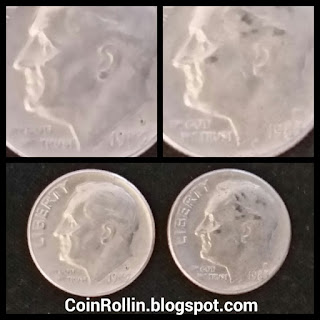
The one on the left was found in the customer-wrapped roll and the one on the right came out of the bank-wrapped roll.
At this point, it's important to use our gear.
A great book to start us off on this topic is:
The Official American Numismatic Association Grading Standards for United States Coins
According to their website:
"The American Numismatic Association is a nonprofit educational organization dedicated to educating and encouraging people to study and collect coins and related items. The ANA serves the academic community, collectors and the general public with an interest in numismatics."
The ANA will be another great resource for you as you continue to grow. But, let's get back to the coin at hand!
What we have here is a 1983D Roosevelt Dime in circulated condition, meaning that it has been passed around and handled. But, the coin on the left looks better than the one on the right? What we want to figure out is, How much better is the coin on the left against the coin on the right?
So, we could get into a very detailed discussion about the intricacies of grading, but that might scare you off. For now, let's just take an overhead view and if you're interested in learning more, you can explore the reference materials I've provided above.
The ANA breaks their system into 8 major groups:
(MS) Mint State, which shows no traces of wear.
(AU) About Uncirculated, with a little wear shown on the highest points.
(EF) Extremely Fine, with even more wear shown on the highest points.
(VF) Very Fine, moderate wear across the whole coin but the major features are still sharp.
(F) Fine, a bit more wear across the whole coin, but the design of the coin is still clear.
(VG) Very Good, this is a well-worn coin with flat spots in the design and which lacks details.
(G) Good, Even more heavily worn, The designs are visible, but the details are faint in spots.
(AG) About Good, Extremely worn smooth, with parts of the date hard to read, and details are mostly worn away.
And each major group is sub-divided into lesser groups, but we won't go into that right now. Let's just figure out, which major group our coins fall into. So, grab your magnifying glass and turn on a bright light. Let's get to it!
I like to start for from the top of the groups.
Right away, we see traces of wear in both coins. So, this will quickly eliminate the Mint State group.
Next is About Uncirculated. Take a closer look at the high points of the coins. These will be President Roosevelt's temple area behind his eye on the obverse and the flame of the torch on the reverse. Concerning our coins, I see wear in both those areas on the obverse. So, we will continue on to the next grade.
How about Extremely Fine? This condition focuses on only the highest points of the coin. On the obverse, they will be the hair lines above the ear, the cheeks, the ear itself. On the reverse, they will be the details of the flame, and the lines on the torch. Overall, we must also consider the luster of the coin. Luster is the shininess of the coin. Right away, we see that both of these coins are dull. That will exclude them from this group.
Then, there is Very Fine. Is there light, even wear? Are all the major features sharp? Look closely, now. On the obverse, can you see the details in the hair? The ear? and the cheeks? On the reverse, are the lines of the torch defined? How about details on the leaves? We are beginning to narrow it down now. The dullness of both coins shows light even wear. Also, there are still details in the hair, and ear of both coins, but they are smooth. However, the coin on the right shows rub marks on the highest points, which are not present on the coin on the left. Let's keep going.
Fine condition. Do the coins show moderate to heavy wear? I would say, "Yes". Is the entire design clear and bold? "Yes" again. So, what about the details in the hair? Are half the details worn away? For this question, it would be a good idea to find a coin from the latest year. Something from 2016 would be fine. Compare the lines in the hair you see to this newest coin, against the lines you see in your birthday coin. My two coins from 1983 are showing more wear on the hair lines. I would feel comfortable placing them in this group more than the one above. Let's keep digging.
What about Very Good? Are the coins well worn over all? Are the designs clear, but flat in the high points and lacking details? Clearly, these coins are still showing their high points. Tilting the coin at a sharp angle under the light, there is no evidence of any flat areas of the highest points. We can still make out the detail lines in the hair. So, I think the coins we have are both in a higher grade than very good.
This is a good place to stop. Both coins appear to be in Fine condition. But, the coin on the left has less wear than the coin on the right. This is when you will get into studying the details of the subclasses.
As you gain more experience, you will learn to identify the finer details of the subclasses. But, for now, I think we're safe calling these coins Fine condition coins. And we will just drop the one on the right back into circulation, as it is clearly less attractive than the one on the left.
So, there you have it. This is a great way to get to know your coins and appreciate the artistry of their designs. Grading your coins will make it easier to identify better coins out of the pile more quickly, and make the quality of your collections much more appealing.
Thank you for joining me on another numismatic adventure and add your comments and coin-related questions below.
I will guide you through another numismatic adventure as we begin to explore the detailed work of grading your coins!
Grading coins provide us with a systematic way to describe the condition and appearance of our coins.
Let's take a closer look at the Roosevelt Dimes we found yesterday.

The one on the left was found in the customer-wrapped roll and the one on the right came out of the bank-wrapped roll.
At this point, it's important to use our gear.
A great book to start us off on this topic is:
The Official American Numismatic Association Grading Standards for United States Coins
According to their website:
"The American Numismatic Association is a nonprofit educational organization dedicated to educating and encouraging people to study and collect coins and related items. The ANA serves the academic community, collectors and the general public with an interest in numismatics."
The ANA will be another great resource for you as you continue to grow. But, let's get back to the coin at hand!
What we have here is a 1983D Roosevelt Dime in circulated condition, meaning that it has been passed around and handled. But, the coin on the left looks better than the one on the right? What we want to figure out is, How much better is the coin on the left against the coin on the right?
So, we could get into a very detailed discussion about the intricacies of grading, but that might scare you off. For now, let's just take an overhead view and if you're interested in learning more, you can explore the reference materials I've provided above.
The ANA breaks their system into 8 major groups:
(MS) Mint State, which shows no traces of wear.
(AU) About Uncirculated, with a little wear shown on the highest points.
(EF) Extremely Fine, with even more wear shown on the highest points.
(VF) Very Fine, moderate wear across the whole coin but the major features are still sharp.
(F) Fine, a bit more wear across the whole coin, but the design of the coin is still clear.
(VG) Very Good, this is a well-worn coin with flat spots in the design and which lacks details.
(G) Good, Even more heavily worn, The designs are visible, but the details are faint in spots.
(AG) About Good, Extremely worn smooth, with parts of the date hard to read, and details are mostly worn away.
And each major group is sub-divided into lesser groups, but we won't go into that right now. Let's just figure out, which major group our coins fall into. So, grab your magnifying glass and turn on a bright light. Let's get to it!
I like to start for from the top of the groups.
Right away, we see traces of wear in both coins. So, this will quickly eliminate the Mint State group.
Next is About Uncirculated. Take a closer look at the high points of the coins. These will be President Roosevelt's temple area behind his eye on the obverse and the flame of the torch on the reverse. Concerning our coins, I see wear in both those areas on the obverse. So, we will continue on to the next grade.
How about Extremely Fine? This condition focuses on only the highest points of the coin. On the obverse, they will be the hair lines above the ear, the cheeks, the ear itself. On the reverse, they will be the details of the flame, and the lines on the torch. Overall, we must also consider the luster of the coin. Luster is the shininess of the coin. Right away, we see that both of these coins are dull. That will exclude them from this group.
Then, there is Very Fine. Is there light, even wear? Are all the major features sharp? Look closely, now. On the obverse, can you see the details in the hair? The ear? and the cheeks? On the reverse, are the lines of the torch defined? How about details on the leaves? We are beginning to narrow it down now. The dullness of both coins shows light even wear. Also, there are still details in the hair, and ear of both coins, but they are smooth. However, the coin on the right shows rub marks on the highest points, which are not present on the coin on the left. Let's keep going.
Fine condition. Do the coins show moderate to heavy wear? I would say, "Yes". Is the entire design clear and bold? "Yes" again. So, what about the details in the hair? Are half the details worn away? For this question, it would be a good idea to find a coin from the latest year. Something from 2016 would be fine. Compare the lines in the hair you see to this newest coin, against the lines you see in your birthday coin. My two coins from 1983 are showing more wear on the hair lines. I would feel comfortable placing them in this group more than the one above. Let's keep digging.
What about Very Good? Are the coins well worn over all? Are the designs clear, but flat in the high points and lacking details? Clearly, these coins are still showing their high points. Tilting the coin at a sharp angle under the light, there is no evidence of any flat areas of the highest points. We can still make out the detail lines in the hair. So, I think the coins we have are both in a higher grade than very good.
This is a good place to stop. Both coins appear to be in Fine condition. But, the coin on the left has less wear than the coin on the right. This is when you will get into studying the details of the subclasses.
As you gain more experience, you will learn to identify the finer details of the subclasses. But, for now, I think we're safe calling these coins Fine condition coins. And we will just drop the one on the right back into circulation, as it is clearly less attractive than the one on the left.
So, there you have it. This is a great way to get to know your coins and appreciate the artistry of their designs. Grading your coins will make it easier to identify better coins out of the pile more quickly, and make the quality of your collections much more appealing.
Thank you for joining me on another numismatic adventure and add your comments and coin-related questions below.
Be sure to Subscribe to my YouTube Channel to get even more videos! And, be sure to Like and Comment as well, so that I can continue to produce content you enjoy and want to see.
Get ready for our next big hunt!
You will need two rolls of coins.
1 - bank-wrapped roll of dimes.
1 - customer-wrapped roll of dimes.
Happy Hunting!
Get ready for our next big hunt!
You will need two rolls of coins.
1 - bank-wrapped roll of dimes.
1 - customer-wrapped roll of dimes.
Happy Hunting!
Subscribe to:
Posts (Atom)